
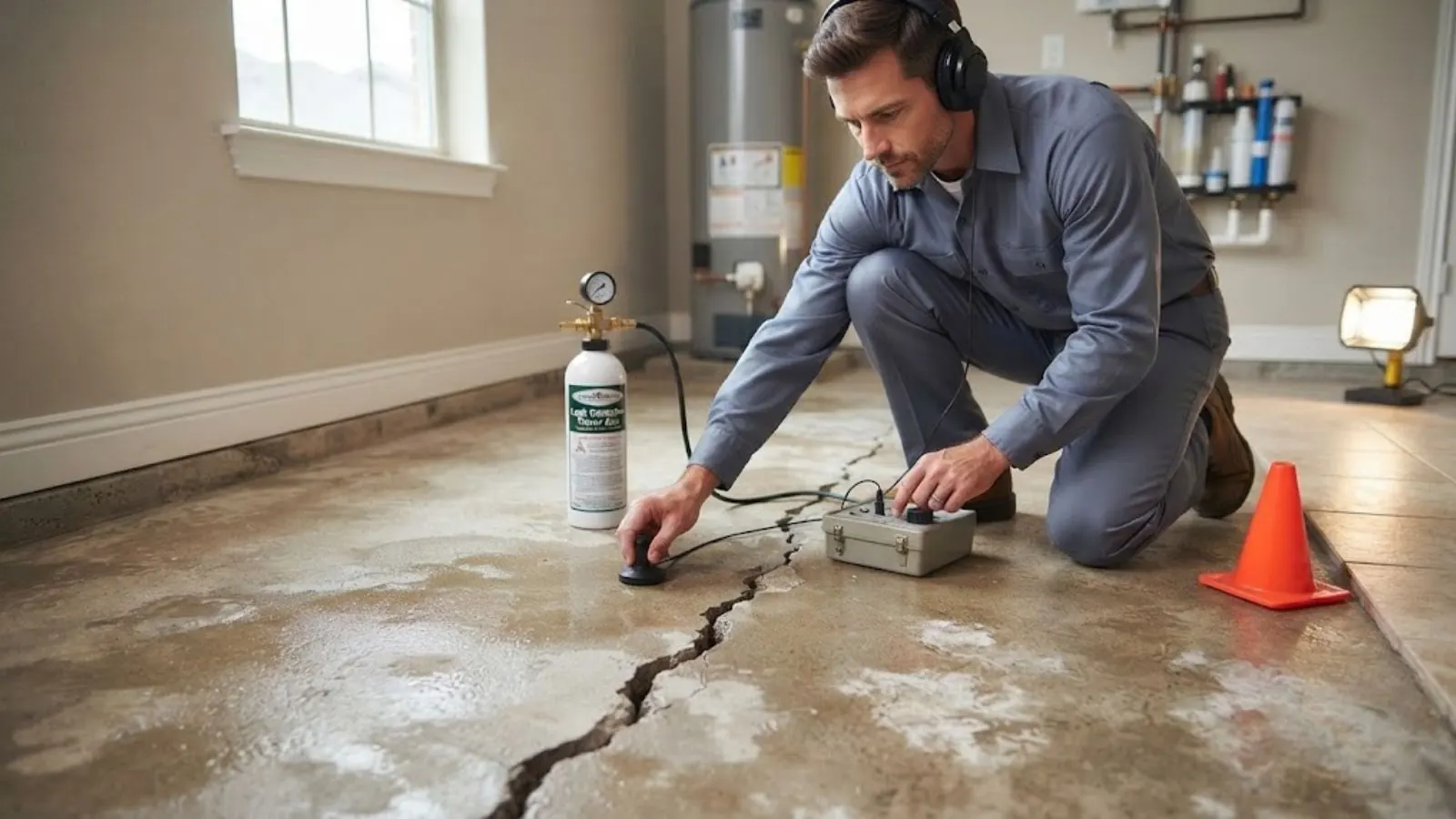
How tracer gas detection works
The technician isolates the water line, drains it and fills it with a mix of helium and nitrogen under low pressure. Helium molecules are tiny and escape through even the smallest hole. A sensitive detector passed over the floor or wall picks up where the gas surfaces, which marks the leak's location above the pipe.
The advantage is that it does not rely on water, sound or heat. It can find a pinhole that makes no noise and leaves no stain. The disadvantage is that it needs the line isolated and drained, so it takes more setup than a quick acoustic check.
Where tracer gas is the right choice
Slab leaks
Pipes under a concrete floor cannot be seen. Gas rising through the slab marks the spot before cutting. See slab leak repair.
Walls and ceilings
A leak behind finished surfaces can be traced without opening the whole wall.
Quiet leaks
A very slow leak makes little noise for acoustic equipment to hear.
Second opinions
When one method failed to find the source, a different method can confirm.
Leak detection methods compared
| Method | How it finds the leak | Best for |
|---|---|---|
| Water meter test | Checks if the meter moves with everything off | Confirming a leak exists |
| Acoustic listening | Amplifies the sound of escaping water | Pressurized leaks that make noise |
| Thermal imaging | Spots temperature differences from hot water leaks | Hot lines in slabs or walls |
| Tracer gas | Detects gas escaping through the hole | Quiet or hard-to-hear leaks |
| Camera inspection | Looks inside drain and sewer lines | Drain leaks, not supply lines |
Start with the meter test
Before paying for any detection method, check whether you actually have a leak. Turn off every faucet and appliance, find your water meter and look at the low-flow indicator, often a small dial or triangle. If it spins or moves, water is going somewhere.
Then close the main shutoff to the house and look again. If the meter stops, the leak is inside the house. If it keeps moving, the leak is between the meter and the house. That tells us where to look and avoids chasing a problem that is in the yard and not the slab.
Water use, leaks and local guidance
The Coachella Valley Water District runs conservation programs for homeowners, and a hidden leak is one of the quietest ways to waste water and run up a bill. The district also publishes its annual water quality report, which can help you judge whether water chemistry plays a role in pipe corrosion at your address.
Repairs that involve cutting a slab or opening walls may need a permit. The City of Coachella Building Division handles plumbing permits and is open Monday through Thursday. Ask before work starts, so the repair does not create a paperwork problem when you sell.
Source types: Coachella Valley Water District conservation page and annual report, and City of Coachella Building Division page.
What happens after the leak is found
Once the spot is marked, the plumber chooses between three repairs. A spot repair opens the slab or wall at that point and replaces the damaged section. A reroute abandons the leaking line and runs new pipe through the attic or walls. A full repipe replaces the supply lines when corrosion is widespread.
The right choice depends on how many leaks are developing. One pinhole in an otherwise healthy line justifies a spot repair. Several pinholes in different places suggest the whole line is wearing out, and the cheapest repair becomes the one that stops the cycle.
Preparing your home for a detection visit
Clear access to the main shutoff, the water heater and any visible plumbing. Move furniture off the area you suspect so the sniffer can pass over bare floor. If your floors are covered with thick carpet or padding, mention it, because the technician may need to pull back a corner to read gas close to the surface.
Tell the plumber what you have noticed and when. A warm patch on a tile floor, a hissing sound at night, a damp baseboard or a bill that jumped in one month all narrow the search. The more specific your notes, the less time the technician spends confirming basics and the more time goes to the actual find.
What to compare when you get quotes
Ask whether the quote covers detection only or detection plus repair. Ask whether a second visit is billed if the first reading is inconclusive. Ask how the plumber restores the surface after cutting, because tile, hardwood and polished concrete each need different handling. A quote that spells these out is easier to compare than one that gives a single number.
Be wary of any company that promises to find every leak with one method. Honest technicians say that conditions matter, that several methods sometimes work best together and that a repair plan follows the finding. The goal is to stop the water and protect your home, not to sell the most expensive option.
After the repair: stopping the next leak
Pinholes tend to cluster where water pressure is high or where chemistry is aggressive. Ask the plumber to check your pressure at a hose bib. If it is high, a pressure regulator protects every line and fixture. Also look at the line material, because copper that failed in one place may be failing at others of the same age.
Keep the repair paperwork with your house records. If you file an insurance claim later, a dated report showing what failed and how it was fixed supports your case. Many policies treat sudden leaks and slow leaks differently, so document the timeline as you know it.
Common questions
Yes. Helium is inert and non-toxic, and the mixture used is harmless at the low pressure involved.
No. It is non-invasive, and the sniffer reads gas coming through the surface without cutting anything.
It can narrow a leak to a small area, though accuracy depends on slab thickness and floor coverings.
Not always. A visible spot may be close to the leak, but water can travel before it appears.
Yes. Most meters have a low-flow indicator. If you cannot find yours, call us and we walk you through it.